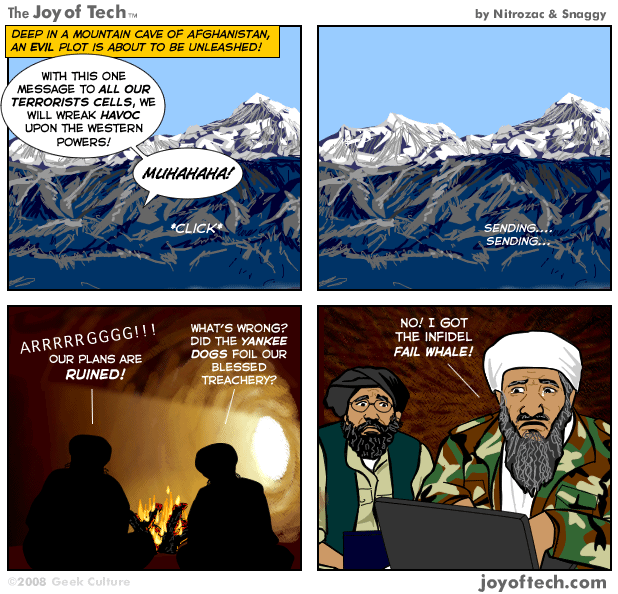
Tuesday, April 21, 2009

Too Much Information? How ICTs affect law enforcement, civil liberties, and terrorism

by Ryan Kushigemachi

Information and communication technologies (ICTs), as the name suggests, enhance our capacity to access and communicate information. How does this affect security? 'Security' means protecting against threats such as terrorism as well as enforcing laws. A government's security powers are often limited by competing interests such as civil liberties. This tension and balancing becomes a security-liberty debate. ICTs change the playing field, creating new challenges for policing, counter-terrorism, and civil liberties.


Simply put, knowledge is power. Both state actors and terrorists gather intelligence which will help further their goals. Terrorists can use technological tools such as mobile phones and href="http://www.nytimes.com/2008/12/09/world/asia/09mumbai.html">Google Earth
to reconnoiter targets. Agencies such as the NSA monitor ICTs to locate and identify potential terrorists. Civilians use Twitter to rapidly communicate relevant information during crises.


Each example poses security
questions:


  • How should government treat these new technologies?
  • What is the role of ICT providers in all this?
  • Is it appropriate or effective to mine ICT traffic to find possible terrorists?
  • What can or should we do about terrorist use of technology?

ICTs are shrinking the globe. They increasingly transcend spatial and temporal boundaries, making communication and information exchange more efficient. Yet historically, the scope of state jurisdiction and enforcement has been tied to spatial concepts: 'national borders,' 'privacy of the home' and 'sovereign territory.' Joel Reidenberg argues
that state jurisdiction and enforcement can and should be exercised online
through various means. Enterprising criminals should not be able to href="http://en.wikipedia.org/wiki/Katz_v._United_States">use ICTs to href="http://www.oag.state.ny.us/media_center/2003/feb/feb11b_03.html">escape
state jurisdiction. States have both technological and policy tools to combat criminal use of ICTs. However, it is difficult to effectively implement enforcement tools in an ICT context. Doing so frequently yields unintended consequences.

Filters are often overbroad, restricting legitimate access.

Demands that providers such as eBay or Yahoo prevent access to content (Nazi
memorabilia, e.g.) where prohibited by law are difficult to enforce just for that locality. This frequently results in blanket action by providers which prevents href="http://www.internetnews.com/ec-news/article.php/758221">all users
(not just the affected locality) from accessing such content. Using intermediaries such as internet and search providers for enforcement is problematic in more ways than one. The third party doctrine reduces privacy and Fourth Amendment protections for data relinquished to a third party. In an era when so much of our lives are online, Google and our ISPs probably know more about us than we do. href="http://en.wikipedia.org/wiki/Cloud_computing">Cloud computing will
only exacerbate this trend.


How do you identify potential terrorists before they strike? 'Data mining' is a frequent answer. Daniel Solove defines data mining as "creating profiles by collecting and combining personal data, and analyzing it for particular patterns of behavior deemed to be suspicious. Solove argues that the security-liberty debate is not always a zero-sum game. Currently, though, while data mining has
potential, it is difficult to assess its effectiveness, excessiveness, or exercise meaningful oversight. This tilts the balance against many liberty and privacy concerns. Data mining may implicate interests such as equal protection, due process, or free speech and association (via a ‘chilling effect’). One of the idiosyncrasies of ICT development is that newer technologies such as e-mail are often less constitutionally-protected than older ones such as postal mail. ICTs not only make it easier to speak, but easier to listen in.


After the Mumbai terror attacks, cities such as New York, London, and Washington D.C. considered disrupting ICT services in the event of a terrorist attack. If terrorists plan to use ICTs as tools, why not take their tools away? The problem is essentially utilitarian. The larger number and greater resources of non-terrorists versus terrorists generally suggests that it is better not to disrupt ICTs during a terrorist attack. That is, non-terrorists derive greater utility from ICTs than do terrorists. Terrorists already have the advantage of planning. During an emergency, ICTs allow the public to communicate with each other and authorities. This accelerate the flow of information, allowing for a quicker and more informed response. Finally, although ICTs pose novel challenges, let's not lose our sense of perspective.

Tuesday, April 14, 2009

The Political Economy of the Internet and Hyperpolitics

By Yeraldy Torres

The internet developed in the U.S. so the policies it goes by today were tailored to American standards although not all countries abide by the liberty encompassed in the ways of the internet. Libertarians opposed the government having the power to regulate content on the internet. This would break the rights to freedom of speech and expression. “Because the TCP/IP protocol was designed to allow communication to flow around blockages in the network, many believed it was effectively invulnerable to censorship,” (Farrell 5) leading libertarians to believe the internet was within impossible reach of the government’s control. Because the government does not have control, it is all in the hands of firms and the people to regulate. So is this a better option? Will the people make the internet the best that it can be without federal intrusion and regulation or should we expect the government to intervene when the unrealistic expectations of the internet have been created?

Bad things will still happen, such as widespread pirating and child pornography among others, but does to good outweigh the bad? I believe so. The internet is truly American (with its defects and all). Anything and everything can be available online and the government cannot regulate, except for under certain circumstances. This may be best because as with the internet, the government only steps into the market when the economic well-being of society is in danger so they break down monopolies and install price ceilings and floors. The U.S experiences very little of this regulation but countries such as China set up huge firewalls to block inappropriate sites while France and Germany attack eBay and Yahoo! for selling neo-Nazi paraphernalia. The sites removed this material because they stood to lose more if blocked by an entire nation for selling one product. So are the demands of a society going to influence what is available online? Or will another smaller site begin selling this and be altogether blocked by the select nations?

Everyone online is connected. Mark Pesce proposes the idea that “hyperconnectivity begets hypermimesis begets hyperempowerment.” The threat to society and democracy is sharing. The world is connecting at faster rates than ever before with easier and simpler methods. With these resources you’re connected to the world, informed, therefore part of a society driven to be connected. The technologies used have been readily available but it has taken time to discover the full potential of things such as texts, wikis, and the internet. These tools keep us all connected and through hypermimesis we mimic and learn how to use the resources available in order to stay connected. So is it becoming instinct to stay connected and informed? Is it a social norm to follow these standards because through just mimicking, no deep brain-racking methods, we learn how to keep up with the technology. It has become so easy to learn the methods of staying connected so is it a good or bad thing that everyone is wired and seeking their piece of the pie of power? Pesce offers that we are redefining the rules and creating a new set of mob rules. These new set of rules require for everyone to be connected, so now all these people have voices and are seeking power, hyperempowerment. So is this a threat to democracy? On a side-note, the 2008 Obama campaign led an internet-based campaign that was hyperconnected. So since hyperconnectivity begets hypermimesis begets hyperempowerment, people seek power in the campaign and as in the internet there is no central power. Obama is not the center, and everyone seeks power. So is this effective? What happens to all the people of the mob seeking power when the campaign is over? The truth is all this power does not exist. People online want power and they want it fast; our democracy cannot permit that because government is meant to work slowly. The internet and its new rules is creating unrealistic expectations for the government especially.

Mark Pesce, http://www.edge.org/documents/archive/edge252.html

Henry Farrell, http://www.henryfarrell.net/internet.pdf

Thursday, April 2, 2009

Information and Communication Technology

by Michael Young

The digital revolution is upon us. Alberto Masetti-Zannini talks about the roles and issues he has with Non-Government Organizations (NGOs) throughout his article. His article touches on some main points about the issues that are upon us in bridging that gap between developed and non-developed countries. We are all a part of this revolution that puts endless knowledge and information at our finger tips and only a click away. But how do we aid those who are not able to keep up with this revolution for any number of reasons: cost, infrastructure, or literacy. Zannini elaborates his issues with NGOs and weather they are really exploiting the full potential of the technology, or using it as a campaigning or marketing device. Are these the only issues with the aid form NGOs, or are there more that isn’t really talked about?

This information and communication technology revolution is here. Web 2.0 is the new generation of tools that allow us to do so many things, in particular the two way interactions that it is built for. The open source technology and information is there for everyone with the ability to have access to that internet. No other tool in the world allows for an individual to have the access to any and all information in front of them. But what good is all this information if they have no access to it? Is technology the answer to helping these countries and are NGOs that answer?

NGOs have the ability to fund, bring in technology, or infrastructure to these rural areas that have no such thing. This technology can bring endless opportunities for these communities that have had no such technology before. These opportunities, as sited in the article, a fisherman in India is now able to check market prices for their goods using a mobile phone that would not otherwise be available to him. Such projects as the $100 laptop that have already begin where they can bring this technology into their homes. This technology can do so much for a child by just allowing them to have access to information that they never had the ability to access before. Other NGO projects such as the Intel billion dollar project have already been implemented. This project is bringing computers and infrastructure to the corners of the world that have never had this technology before. This allows for an endless of opportunities for these villages and their kids that have had no such formal education. While all this is seems to be perfect there are always underlining issues.

Zannini’s main issue with NGOs is that he believes they are not using this ability to bring this technology and internet to these communities to their full potential. Also claiming that they are using or approaching this situation or responsibilities as a campaign or marketing deceive. Do NGOs see this as an opportunity to get their product out there and not really thinking about helping these countries? Maybe, but there are many other underlining issues are present and aren’t talked about. Such issues can be the limitations that the state government puts on these NGOs and what they can do. Some concern is made to this technology being a negative impact on their culture.

There is no one correct answer to solving the problems of the undeveloped country. NGOs do have the ability and responsibility to help with this. Weather they are promoting their product or helping these communities they are still providing them with something they have never had access to before. The information and communication technology seems to be the quick and best fit to giving them the tools to be more productive, better education, and possibly lead to a better life.

Wednesday, March 25, 2009

Open Source Politics

Open Source Politics is no longer a “wave of the future” phenomenon. Rather, it has now become a present day lifestyle. In the simplest of terms, open source politics is a methodology in which social networking and electronic civic engagement has revolutionized the ability to follow, support and influence particular areas of politics. The question isn’t whether open source exists, is effective, or even serves a purpose. Open source has been blatantly utilized through the YouTube debates during the presidential campaign, The Smirking Chimp and twitter-feeds for major news networks. Instead, the question of Open Source is assessing the enhancement and pitfalls, and whether limitations can or should be placed without infringing upon our 1st amendment rights. Richard Barbrook’s article Virtual Dreams, Real Politics examines the influence the Cold War has had on the new online generation. A technological revolution in essence promised democracy within an undemocratic state – this leads to the question: can free social networking exist in an “unfree” environment? Soviet communists dove into computerization headfirst, believing they could achieve socialism, yet could never make a complete transition without some sacrifice to power. BBC News reported on a 2003 study done by Reporters Without Borders (RWB) divulging the degree of censorship existing within Chinese chat rooms. RWB estimated the state utilized nearly 30,000 employees to monitor all online activity. A grading scale of 1-10 was implemented (harmless postings to severe criticism of the government) and 70% of level 7/8 were removed within a few hours of being posted. The “Self Disclipline Act” requires organizations to weed out postings related to banned topics, including (but not limited to): human rights, Taiwan independence, pornography, oral sex and Sars. Take this censorship issue straight to the United States in terms of Wikipedia. Nicholas Carr’s blog Rise of the Wikicrats references the rapid deletion of new articles. He likens the infiltrators to the infamous Soup Nazi – if George Costanza cannot get his turkey chili, why should Carr be able to post arguably “irrelevant” text online (as determined only by the elite)? I think this reinforces Marshall McLuhan’s idea that the knowledge elite, rather than the proletariat makes history. How free is free social networking? Open Source is meant to execute democracy in the way democracy should be executed: immediately and frequently in a widespread manner. All should be exposed and all can decide how to take part. Weblogs and Emergent Democracy by (mostly) Joichi Ito describes an essay that has been mass circulated, peer reviewed, and edited by the commons. Democracy mean to expand upon the social software. The internet was supposed to be a gathering place to correct imbalances and therefore must be developed appropriately within reason to avoid tyranny of the majority. A second question is then introduced: can social networking eventually lead to an overthrow of traditional news? When Trent Lott made racist remarks, he became a media story before eventually fizzling away. Blogs continued coverage, digging into his past until Lott resurfaced in the news. When conventional media provides only clips and sound bytes, the online community can help give the ‘full scoop,’ however irrelevant or meaningless the content may be. Even though blogs perpetuate discussion, is their ever hope for redemption? Newspapers may be forgiving, but the determined cyber-users continue to press, hound and report. Open Source Politics is a fundamental expression of true democracy. Douglas Alexander states the driving force of politics has always been the capacity for change and betterment. My only concern is that he continuous strive for “change” will lead us back to pre-constitutional times. If all becomes free does that mean nothing will be free?

Wednesday, March 18, 2009

From CounterCulture to CyberCulture

by Kris Winstrom

In the article “From Counterculture to Cyber culture” , the author, Turner brings to light, how the internet on the one hand stemmed from the techies of the 60s and 70s, but also the Countercultural movement of the time. However, when one think of a countercultural movement or system today, the internet is not usually the first thing that comes to mind. This is, as the author claims, because we now live in a Cyber culture.

To me this seems like one of the most effective countercultural movements in our history. Not only has it changed our culture, system and the ways we look upon our world, but furthermore after an initial slow start it exploded into our lives in a way that make us think that this is the only system, which without, we would not survive. Some people would argue that the internet is in fact not Countercultural anymore, which I disagree with. It has broken down many of the walls of bureucracies as the early innovators hoped and the very nature of the internet challenges the market and society we live in.

Its ironic that the hippie ideals of the 1960s and 70s, which where so heavily scrutinized, are not at all left behind us, but has reemerged stronger then ever before thru the internet. Peer-to-Peer production, with no monetary incentives, but instead rather based on the incentive of group recognition, is very much something counter cultural in my opinion and yet people don’t see it. With this said, I am not stating that the internet is bad, but rather that the internet has changed and continues to change our culture in ways that may turn out pernicious. Because no one can negate the fact that the internet enables people to attack and severely damage our lives, culture, government and other social systems.

Another interesting aspect, is that of the hackers. Many will argue that hackers do more to push technology then the “planners” and other type of innovators. This hypothesis is based upon how they are thinking outside the box and are not contained by laws and other types of rules. This might very well be true, however, I would argue that the hackers often push the technology in the wrong direction and do not consider the macro picture. Furthermore, ethics are often not considered by hackers and I have a hard time with agreeing to their small exclusive groups being the real innovators of the internet and the world.

Wednesday, February 25, 2009

Thoughts on Benkler

by James de Haan

Networked Information Economies; according to Yochai Benkler, the man behind the term, is a "system of production, distribution, and consumption of information goods characterized by decentralized individual action carried out through widely distributed, nonmarket means that do not depend on market strategies". The internet is a new form of information exchange that seemingly allows this to happen; the information technology of the internet allows for unprecedented amounts of collaboration, to a point that simply hasn’t been seen before. Creative Commons, Wikis, and open source are all examples of the good this level of collaboration brings; Benkler’s own book on the subject was even published in creative commons. He goes on to argue that this level of communication allows for a culture to be much more self reflective and empowered than it would be otherwise; we see this already with the blog phenomenon, wherein a large number of people eager to be relevant and to have their opinions matter jump onto a system has the power to seemingly do that.

From this new system of communication, a new form of production has seemed to come through; that of a cooperative, non-market based model. And when I say non-market based, I mean that in the strictest of senses; it literally has little basis on physical money and, while certain market principles still hold true, it is not dependent on money. Rather, it is dependent on the community and how they view you and your production. This, in Benkler’s view, is what makes networked information economies so democratic; the consumer and the producer are at the same level and have the same say in things. Contrast this with a industrial information economy in which monetary and physical capital constrained this from happening and you see a new form of economy that one would be foolish not to wish to be a part of.

But what of motivation? After all, can a group of consumers really be motivated to do something that does not have any monetary gain in it. In Benkler’s eyes, this is an oversimplification; people cannot simply be reduced to positive and negative utility whose actions can be translatable to money. He gives this example; “If you leave a fifty-dollar check on the table at the end of a dinner party at a friend's house, you do not increase the probability that you will be invited again.

We live our lives in diverse social frames, and money has a complex relationship with these - sometimes it adds to the motivation to participate, sometimes it detracts from it.”[1]

He goes on to discuss the viability of there being two markets; one based on social incentive, one based on monetary incentive. One market does not directly respond to the incentives of the other, but the market based on monetary incentive could lead to desperate people selling faulty product; the example he cites is the blood market, with people with bad blood seeking to sell and those with good indulging in the altruistic model. So there are two markets with two different rewards; one leads to higher economic standing, and one to higher social standing. The blood example is a pretty good way to show how communities can work in web 2.0; we don’t do it because we get money, we do it because we get fame and this system can even prove more efficient.

But will any of this pie in the sky market idealism work? I don’t believe so. Benkler sees this new networked information-based economy as joining hands with the market based; social standing and monetary benefits work together to motivate more efficiently than simply market incentives alone. Right now, you need a lot of social standing to motivate as well as money can; I can’t do much, even in my group of friends, but if I monetize their reward for fulfilling my demand they are much willing to do it. That isn’t to say my standing socially doesn’t help with this, but money works quicker and better. Even if society adopts this new community-based incentive system, it still wouldn’t be as efficient and easy to motivate, as it was with money alone. So maybe we are moving to a point where what we add to a production is valued higher than it is now, but the two systems will never go hand-in-hand in the way Benkler envisions.

[1] - http://www.congo-education.net/wealth-of-networks/ch-04.htm#4-1

Wednesday, February 18, 2009

User Innovation Networks

by Jennifer Arcero

User innovative networks are “not suppose to exist “in others words they are anomalies which defy one of the underlying principals of economics. Community innovative projects continue to arise, despite their nature which can seem quite frankly gain less. The benefits from these user innovative projects are hard to detect if one is uninformed of the process and community of users. The tedious nature of code writing causes one to think, “Why would you just simply give away your work?” It just makes sense, user innovative community’s work together to tailor a product which fits their needs. Authors of code generally produce code to create a product to fit their needs avoiding inefficient manufacturers and of course the high cost of manufactured programs.

Programmers release their code to the public but that does not affect the use of their code; they constructed the code to serve their own purpose. Programmers release their “DNA” allowing others in their community to genetically modify their original product thereby allowing the creation of new innovative programs. The programs which arise from the parent “DNA” may be useful for the original writers cause. Sharing the code prevents the “reinvention of the wheel” allowing greater productivity. For example, when a group of scientist mapped the human genome they did not keep their work cooped in their inner circle, instead they allowed other “free riders” to use their findings. Free Riders can provide a service for producers they can find glitches and can add their own knowledge to create a better product. Free riders unknowingly provide a service for the producers. This creates the opportunity for multiple tools to stem from one central source. The community can then create more specific and tailored programs which will better fit the community’s special interest. The easiest way to explain this is “if you want things done right… Do it yourself! Who else can better design a tool than the person seeking the new tool? This is a new and innovative path to acquiring what you want faster, better and cheaper.

The effectiveness of user innovation is surprising, the structure and the communication within the group is impressive. The question is how sustainable is this system? If one cornerstone of the system fails will it all fall? Yes, the open source network is dependent on passion, organization and recognition without structured community and the aspiration to become part of the “core” is removed. The sense of earning respect and weighted say is essential to open source because it drives the ability of a group to maintain its project goals. The "open" in open source is one of the major components essential to the survival of the open source project themselves. The generosity of the authors positively affects their group as well as themselves. Peer review and revision helps eliminate or at the least detect errors more efficiently. Allowing the creation of a better product, where not just a select few review but the masses come together to peer review one another’s work. As Hippel explains, open source is the proof that communities can create product without the middle man. The elimination of this middle man will increase the potential for growth and extended innovation. My question is how open source is affecting the way we operate, what if open source can lead to group based mass production rather than the corporate based production. Shifting the way corporate America works? This is obviously an idealistic hope, which would most definitely result in the reinvention of corporate and manufacturing system. The real question is, will this change be better for our market??
It will be interesting to see how open source changes the way we operate as consumers, will we lose respect for the professional photographers, will we never pay for another program or will we just demand lower prices and better product in order to compete with the freeware out there. The internet and freeware is undeniably changing the manner in which society operates but because we are currently living the change it is hard to evaluate the extent of its influence over our lives and how this is changing the way we operate and it may be possible that our entire lives is moving online, whether working collaboratively online, creating and sharing online.

Tuesday, February 10, 2009

The Long Tail: Misses are no Longer Bad

by Andrew Paster

With such a variety in the market these days, it is rather difficult to appeal to everyone. Stores cannot always stock what appeals to the few people who have non-conformist needs. In order for a business to be successful, it must make a profit. The best way to do this is to appeal to the masses. By selling “what’s new” or “what’s hot”, a business is guaranteed to generate enough profit to progress. Although satisfying the masses takes care of most people, how are those “others” satisfied? It is difficult to satisfy our needs, when those needs are not highly demanded by the masses. In his article “The Long Tail”, Chris Anderson says, “retailers will carry only content that can generate sufficient demand to earn its keep.” This makes sense for an actual store. There is no reason to carry a product that only sells one copy a year. However, that was geared for the 20th century. Before the Internet, “an audience too thinly spread is the same as no audience at all.” This statement completely dismisses all sorts of potential customers. Although a store cannot physically stock every product, it allows for newer technologies and outlets to emerge to satisfy those who cannot so easily accommodate their needs.

Anderson says that, “this is the world of scarcity. Now with online distribution and retail, we are entering a world of abundance.” Who doesn’t love abundance? The Internet provides us with so many options that would never exist. It challenges Pareto’s principle that only 20% of something will be a hit, while the other 80% a miss. With only a one in five chance of success, a miss is easily obtained. The Internet has allowed for this rule to change. Such companies as Amazon and Rhapsody have learned how to take those “misses” and make them successes. Since there are so many misses, the money from them is bound to add up. Since the Internet is free of physical capacities, a miss can be able to be stocked, not costing anything, and only making profit whenever that random person comes across it.

For example, Rhapsody’s online music library stocks well over 735,000 tracks. With such a vast library, stores like Best Buy and Tower Records cannot compete. There are enough songs on Rhapsody for a specific genre to have its own store. The thing about Rhapsody is that as quickly as it adds new content, a few people here or there immediately pick it up. With such offers online, it is hard to see what it is that keeps people continuing to buy from stores themselves. It could be the convenience of getting something while you’re out, or the satisfaction of physically possessing something (as opposed to buying a file from the web). Barnes and Noble stocks roughly 130,000 titles. More than half of Amazon’s book sales come from outside of their top 130,000 titles. It is impossible to physically beat the web when it comes to variety and accessibility.

The most interesting thing I learned and realized while researching The Long Tail came from Chris Anderson’s article. It was something I had never realized, and would never have expected. Returning to online music, it is viewed as a single-driven business, like that of the 1950s. People tend to only purchase one or two songs from an album. This way of buying singles is much like the 50s, where only a few songs from the album were sold as their own separate record. Who would ever have thought that something so modern, new, and efficient would send us back in time? All of this available content allows us to experience new things and diversify ourselves. With such an ease of exposure, the Internet can allow us all to connect and share in a way never known before.

Thursday, September 11, 2008

The Outrage over the Outrage

People are grousing about this "lipstick on a pig" scandal, how it seems a new low for American politics. Rick Shenkman, a history professor at George Mason University, recently came out with a book with the transparent title Just how Stupid Are We? He has the typically littany of statistics on how little people know about the basic working of government or elemental facts about ideas. This research has been confirmed again, and again, and again. He claims that the increased sophistication of public opinion polling and the increased control over political institutions given to the masses gives the people too much power.

Shenkman and others may be right. But It seems beside to point to say that the public is interested in the visceral over the rational. His prescription is that we should "put the people in their place" so to speak and change institutions so that the people do not have as much direct control over their elected officials. But in reality, there seems to be little prospect of either of those recommendations coming to pass.

There's enough research on the brain that suggests that power of emotional appeals over rational ones. It strikes me that we should take this as fact and move forward from there. A more important question seems to be "is there anything of value in the current way voters make decisions about politics." If people are basing their support for a candidate based on their affinity for him/her, then we need to engage the problems of civic engagement on those terms.

It is logical that people vote based on affinity. A recent ABC News poll found that Sarah Palin has 80% support among White women with children. Why? Because of propinquity. Propinquity, or the degree of likeness between people, is a heursitic device used to make a choice in the absence of other information. Herbert Simon used the term satisficing to describe roughly the same thing. People take short cuts in making decisions that are time bound and require large amounts of data. One easy way to make the "safest" choice is to say " If she's like me, then she's likely to understand what I am going through and is likely to advocate for me in the White House. And if she's not advocating for me, then at least it's cool for my daughter to see a Vice President who looks like their mom." Of course there are many among that 80% who are conservative evangelicals and are voting their policy preferences, but for the rest, it is a pretty logical heuristic cue to use when the intricacies of policy seem so remote.

We as social scientists might wish it were different, but let's put the different systems of choice in perspective. On one hand, you vote for someone who supports the policies you support. Given the dense system of checks and balances in the American system, it is unlikely that those policies will be passed. Even if they are, they are not likely to produce immediate results or may very well produce unintended consequences (shout out to Thomas Merton!)

The same goes for what many view as simplistic and disingenouous appleals about "keeping us safe" and "country first." This morning I watched the very moving 9-11 ceremonies and the speech that President Bush gave at the event in NYC. In his speech, he made the observation that we Americans had not been attacked in over 1,500 days. From an emotional brain perspective, that's a powerful argument. It is understandable that a voter might take that portion of the speech and satisfice and say "that's good enough for me." Protection for external threats is a visceral concern. it seems foolish to have an esoteric argument about how people should use more rational decision rules when selecting a president. Until the Democrats can frame their issues in ways that create a visceral concern among the American public, they aren't going to get anywhere. And in one sense, they probably shouldn't.

Monday, September 8, 2008

Thickculture is Moving to Contexts Blogs

Dear Army of readers:

I am very excited to announce that this blog has moved to the family of blogs associated with Contexts magazine. For those of you not familiar with Contexts, it is a publication of the American Sociological Association. The magazine does a wonderful job of making sociological research accessible to a wide audience and my hope is that the blog can contribute to broadening their mission of public sociology to the social sciences in general.

I will also be announcing new contributors to the blog soon!

The new location for Thick Culture is:

http://contexts.org/thickculture/

Thanks,

Jose Marichal

Sunday, September 7, 2008

Why is this blog called "Thick Culture"

Avid readers of this blog, which I'm sure numbers in the tens of thousands, might wonder where the term "thickculture" comes from. Orignially the term was used by political theorist Michael Walzer in a book called Thick and Thin, Moral Argument at Home and Abroad. I'm sure I won't do his argument justice, but in it, he distinguishes between an abstract, baseline common morality which we all purportedly share (basic human rights, self-determination) that he calls "thin" morality and a more contextual, particularistic morality that he calls "thick" morality. What's so valuable about Walzer is his view that "thin" principles must be realized within "thick" cultural contexts and not externally imposed. One quote from Walzer that has always stuck with me is this:

"the left has never understood the tribes."


As Walzer explained here:

Tribalism... is the commitment of individuals and groups to their own history, culture, and identity, and this commitment (though not any particular version of it) is a permanent feature of human social life.


This passage has reverberated with me as I've observed the newfound Republican success in the presidential election. The right has been effective and exploiting this blind-spot in the thinking of progressives. For example, the rapid-response to the Palin VP selection denigrating her for being a "mayor of a town of 9,000" people was a perfect indication of the bias on the left towards "thinness." The implication of the critique is that a town of 9,000 is too provincial, too disconnected from the universal to be of any real consequence to the development of a world leader.

Barack Obama's unfortunate "bitter" comment followed this same track of opposition to the particular, the provincial, as an impediment to realizing universal moral principles. Walzer's great insight is that the abstract and universal has to be realized through the particular and the provincial. It could be that what Obama meant to say is that people "cling" to thickness in the face of global change. But he hasn't really done an effective job of articulating that if it's what he meant.

Today's Gallup tracking poll has a 3 point McCain lead, a lead which will probably grow tomorrow..the first set of polls during which all three days of interviewing were conducted after McCain's Thursday acceptance speech. I think the reason that the Republican convention was so successful is because it tapped into the existing meme on the part of the Democrats that they simply "don't get tribes."

The problem is that "thin" principles matter. While Republicans understand that culture and identity matter as much, if not more, than material gain, they haven't necessarily put in place policies that lead to universal principles of individual self determination and autonomy. They subscribe to a "thin" version of freedom that ignores the role of government in providing individuals with the tools to help people realize their full selves. If people were ok with being allowed to practice their cultural norms undisturbed, we wouldn't have 80% of Americans saying we're headed on the "wrong track."

If Obama is truly to be the transcendent political figure he aspires to be, he needs to realize that the abstract (thin) principles he aspires to needs to be connected to the norms, values, and experiences (thickness) of everyday existence. This is his big mission for the next 60 days, to convince people in small town and suburban America that the "thin" abstract principles he espouses are rooted in "thick" small town norms and values.

Friday, September 5, 2008

Community Organizing Code for Angry Left

The Republican convention had a series of strange attacks on Barack Obama's work as a community organizer. Kevin Harris points to an article in the Nation by Peter Drier and John Atlas taking the RNC to task for their attacks on local civic engagement:

Former New York Mayor Rudy Giuliani delivered his own snickering hit job. 'He worked as a community organizer. What? Maybe this is the first problem on the resumé,' mocked Giuliani.

A few minutes later, in her acceptance speech for the GOP vice presidential nomination, Sarah Palin declared, 'I guess a small-town mayor is sort of like a community organizer, except that you have actual responsibilities.'


The Daily Show (god bless em') had a hilarious take on the comments and crystalizes what seems to be an out of sync contradiction between the campaign's own theme of service and the Republican party's professed belief in local community-based problem solving.


What gives? Me thinks this is suppose to be code for "angry left radical activist." It's meant to be another salvo at the Democrats for being a party full of Marxists trying to "stick it to the man." But anyone who has worked with or studied community organizations know that they have become very mainstream. Many of them have been focused on building low income housing and providing job training. "Community organizing" has moved from an emphasis on political activism to one of asset building and community empowerment...things Republicans are supposed to stand for.

According to his Wikipedia's page, this is what Obama did as a community organizer:

After four years in New York City, Obama moved to Chicago to work as a community organizer for three years from June 1985 to May 1988 as director of the Developing Communities Project (DCP), a church-based community organization originally comprising eight Catholic parishes in Greater Roseland (Roseland, West Pullman, and Riverdale) on Chicago's far South Side.[12][14] During his three years as the DCP's director, its staff grew from 1 to 13 and its annual budget grew from $70,000 to $400,000, with accomplishments including helping set up a job training program, a college preparatory tutoring program, and a tenants' rights organization in Altgeld Gardens.[15] Obama also worked as a consultant and instructor for the Gamaliel Foundation, a community organizing institute.[16]


This might work the way the Republicans intend. But if it does, I have developed quite a tin ear for political framing, which is pretty scary for a political scientist. A backlash has started against the community development snaps Micah Sifry identifies a facebook group called We Are All Community Organizers was launched immediately after the speeches. As of 4pm Pacific time on Friday, September 5, the list had 5,359 members. Of course, it's unlikely many of the people on that list were McCain supporters.

Thursday, September 4, 2008

open source lecture: philosophy of science

In the interest of submitting my work to the wisdom of the crowd, I'm trying out a new way to teach the philosophy of science, using visual cues to articulate concepts. I'd love feedback on how this will go over. I picked:

"Nature Boy" Ric Flair for Popper's Falisifability
The movie "Clueless" for Kuhn's Paradigms
A hive of worker bees for Lakatos' research programmes
Seinfeld's "The Opposite" episode for Feyerabend's counterinduction

Here it is: let me know what you think.